
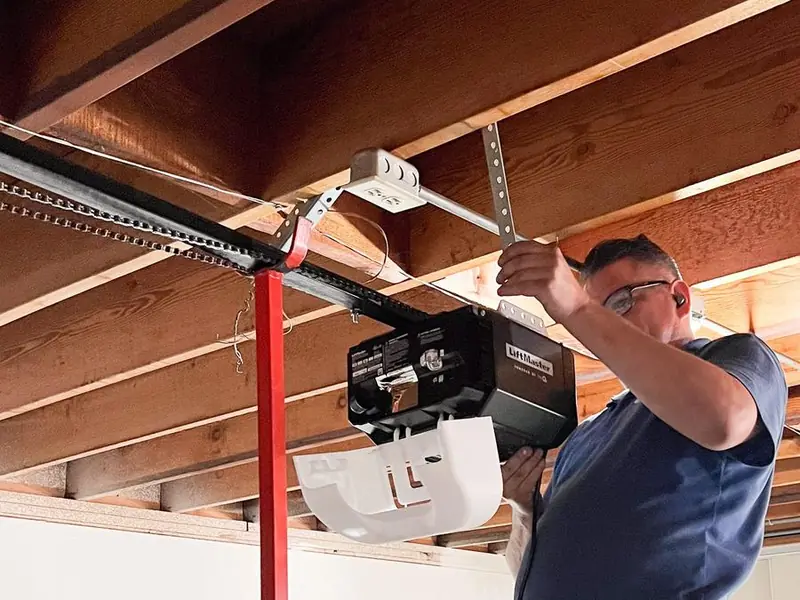
What actually changes in extreme cold
An opener motor doesn't fundamentally behave differently at -25°C than at +10°C — electric motors are fairly cold-tolerant. What changes is everything around the motor: lubricants thicken, plastic components become more brittle, and the door itself gets heavier to move because cold-stiffened weatherstripping and slightly contracted hardware add friction. An opener that's marginal in mild weather often reveals that weakness first in deep Ottawa cold.
Features that matter most for our climate
- Battery backup. Ottawa's ice storms and winter windstorms cause real, sometimes extended power outages. An opener with a built-in battery backup keeps working through an outage — genuinely useful, not a gimmick, in this climate.
- A properly rated motor for your door's weight. An insulated double door is heavier than the opener's minimum spec might assume. Undersized motors strain harder in cold weather when everything else is already adding friction, shortening the opener's lifespan.
- Soft-start and soft-stop technology. Reduces mechanical shock on cold-stiffened components during the first movement of the day, which is when a door is at its coldest and stiffest.
- Quality internal lubrication. Cheaper openers sometimes use grease that thickens noticeably in deep cold, adding load on the motor. Better units use lubricants formulated for a wider temperature range.
Belt vs chain — does it matter for cold weather specifically?
Not much, in terms of cold tolerance — both drive types work fine through an Ottawa winter with normal maintenance. The real difference is noise: belt drives run quieter, which matters more if the garage is attached and near living space. We cover this in detail in belt vs chain drive openers: which for your home.
Smart features: worth it, with one caveat
Wi-Fi-enabled openers with smartphone app control, cameras, and integration with home security systems work reliably through Ottawa winters — the electronics are built for garage-level temperature swings. The one practical issue we see is Wi-Fi signal strength in detached garages or ones at the far end of a property, particularly in older neighbourhoods with thicker exterior walls. A simple Wi-Fi extender solves this in most cases.
What to avoid
- Undersized, budget openers on heavy insulated doors. The motor works harder every single cycle in winter, shortening its life significantly faster than on a lighter door.
- Openers with no adjustable force/travel settings. Cold-weather stiffness changes through the season; being able to fine-tune force settings helps the opener adapt without straining.
- Skipping professional installation on a heavier or insulated door. Getting the travel limits and force settings dialed in correctly matters more in a climate with this much seasonal variation.
Our recommendation for most Ottawa homes
For the typical attached garage with a mid-weight insulated door, a belt-drive opener with battery backup and smart connectivity hits the best balance of quiet operation, winter reliability, and convenience. For a heavier double door or a workshop garage with frequent use, step up to a higher horsepower/torque-rated unit regardless of drive type. We install and service Chamberlain and other major brands built for Canadian winters — see our full opener lineup for current models.
For more on smart features specifically, see our guide on smart garage door openers and smart controllers with Apple Home in Canada. If your current opener is already struggling in the cold, our cold weather won't-open troubleshooting guide can help diagnose it first.
Horsepower and torque ratings, explained simply
Opener strength is usually rated either in horsepower (older or simpler chain-drive units) or in a torque-based rating (common on newer belt-drive and DC-motor units, sometimes marketed with comparative horsepower-equivalent numbers). For a standard single steel door, a modest rating is usually sufficient. For a heavier insulated double door, or any door where the opener seems to strain even slightly, stepping up to a higher-rated unit reduces motor stress significantly — and a motor under less continual stress lasts longer, especially through repeated cold-weather cycles where friction is already elevated.
DC motors vs AC motors in cold garages
Most modern premium openers use DC motors, which offer smoother acceleration and deceleration (soft-start/soft-stop) and tend to run a bit more efficiently than older AC motor designs. In cold weather, that smoother operation reduces the mechanical shock on a door and hardware that's already stiffer from the cold. If you're comparing opener specs, this is worth asking about specifically rather than assuming all openers use the same motor technology.
Maintaining your opener through winter
- Keep the drive rail (chain or belt) lubricated per the manufacturer's recommendation using a cold-rated lubricant, not general-purpose grease that thickens excessively in deep cold.
- Periodically check that the travel limit and force settings haven't drifted, since cold-weather stiffness can occasionally reveal settings that were borderline in milder weather.
- Test the battery backup (if equipped) periodically rather than assuming it will work when you actually need it during an outage.
- Keep the area around the photo-eye sensors clear of winter dust, cobwebs, or condensation — see our sensor troubleshooting guide.
When an opener upgrade makes more sense than a repair
If your current opener is more than 12-15 years old, lacks battery backup, and is starting to show strain — slower operation, more noise, occasional failure to fully close — replacing it rather than continuing to patch an aging unit is usually the better long-term value, especially heading into another Ottawa winter. Older openers also generally lack rolling code security and modern safety features that newer units include as standard.
Noise transmission in cold, dry winter air
Sound can carry differently through a cold, dry garage than a warmer, more humid one, and some homeowners notice their opener seems louder specifically in winter. This is partly perception — a quiet house at night amplifies any mechanical sound — and partly real, since cold-stiffened components can produce slightly more operational noise than the same parts running at room temperature. If winter noise bothers you specifically, this reinforces the case for a belt-drive unit with soft-start/stop technology, which minimizes exactly this kind of cold-weather noise increase.
Backup power options beyond built-in battery backup
If your opener doesn't have built-in battery backup and retrofitting isn't straightforward for your specific model, a small portable power station or manual release remain reasonable fallback options during an outage. The manual release cord disconnects the opener so you can lift the door by hand — worth testing occasionally so you're confident using it if you ever need to during an actual outage rather than figuring it out for the first time in a stressful moment.
Getting a straight answer instead of the most expensive option
It's easy for opener shopping to turn into an upsell toward the priciest unit on the shelf. In our experience, most Ottawa households do very well with a mid-tier belt-drive opener that includes battery backup and basic smart connectivity — the marginal gain from the absolute top-of-line model is often small relative to the price jump. We'll always tell you honestly where that value line sits for your specific door and household rather than defaulting to the most expensive recommendation.
Getting a recommendation matched to your actual door
The right opener depends on your door's weight, material, and size as much as on the opener specs themselves — a recommendation made without seeing your actual door is really just a general guess. We're happy to assess your specific setup and recommend an opener sized and featured appropriately, rather than defaulting to a one-size-fits-all suggestion.
Smart features worth having versus features you'll rarely use
Modern openers offer an expanding list of smart features — smartphone control, integration with home security systems, activity logs, geofencing that alerts you if the door's been left open. In our experience, smartphone app control and open-door alerts are the two features Ottawa homeowners actually use regularly; more elaborate integrations are nice-to-haves that some buy and rarely touch. If budget is a factor, prioritizing a reliable core opener with solid basic smart connectivity over one loaded with rarely-used extras is usually the better value.
How opener placement in the garage affects cold performance
An opener mounted directly above an uninsulated, drafty section of ceiling experiences more temperature extremes than one in a more sheltered position, and this can very slightly affect motor performance and lubricant viscosity inside the unit over time. This is a minor factor compared to the door and opener specs themselves, but if you're doing any broader garage insulation work, improving the ceiling insulation near the opener is a small additional step that supports smoother year-round operation.
What manufacturer support and parts availability really means for you
Beyond the opener itself, consider how easy it is to get replacement parts and manufacturer support for the brand you choose years down the road. Well-established brands with strong dealer networks across Ontario tend to have parts and qualified service more readily available than lesser-known imported brands, which matters if you ever need a specific replacement component rather than a full opener swap.
Not sure which opener fits your door and garage? Call (613) 884-1488 for an honest recommendation, not just the priciest option on the shelf.