
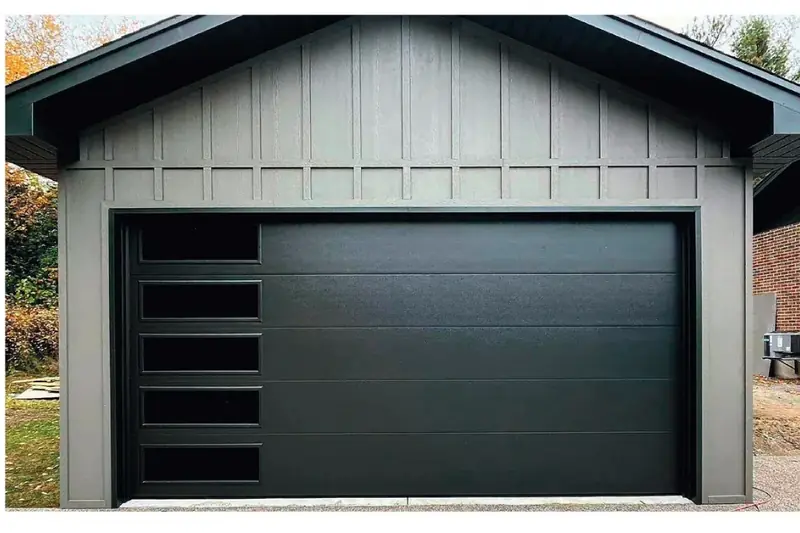
The real question isn't “insulated or not” — it's “what's on the other side of that door”
We get asked constantly whether insulation is “worth it” in Ottawa, and the honest answer depends entirely on your garage's relationship to the rest of the house. A detached garage at the back of a rural Manotick property, used only for the lawn tractor and storage, has a very different case for insulation than an attached garage in a Kanata Lakes two-storey with a bonus room built directly above it.
As a rule of thumb: if your garage shares any wall, ceiling, or floor with heated living space, or if you spend real time in it (workshop, gym, workspace), insulation earns its cost quickly. If it's a fully detached, unheated structure used purely for parking and storage, a non-insulated door is a perfectly reasonable choice and there's no need to pay more.
What non-insulated doors get right
Single-layer steel doors are lighter, less expensive, and still hold up fine structurally in our climate provided the steel gauge is reasonable. For a detached garage or a shed-style structure, that's often the smarter spend — put the budget toward a better opener or hardware instead. The tradeoff is that the inside skin of the door gets cold fast, which in an attached garage means the whole space (and often an adjoining mudroom or laundry room) never really warms up in January.
What insulated doors solve for Ottawa specifically
- Condensation control. A cold steel door in a heated or semi-heated space is a magnet for condensation, which over years contributes to rust on hardware and staining on the interior skin. Insulated doors with a thermal break between the steel skins run warmer and sweat far less.
- Comfort in shared-wall rooms. Bonus rooms over garages, common in many newer Findlay Creek and Barrhaven builds, feel the cold radiating through an uninsulated garage ceiling. An insulated door reduces how cold the garage itself gets, which helps that room.
- Noise dampening. Foam-filled doors are noticeably quieter when opening and closing — a real quality-of-life upgrade if the garage is under a bedroom.
- Door rigidity. Polyurethane-insulated doors are stiffer, which means less flex and warping in wide temperature swings and a tighter seal against the weatherstripping over time.
Reading the R-value label without getting fooled
Manufacturers advertise R-values from roughly R-6 up to R-18+ depending on construction. The number matters, but so does how it was measured — whole-door R-value versus centre-of-panel R-value can differ meaningfully, and marketing materials don't always make clear which one they're quoting. We break this down in detail in our companion post, R-Value Explained: What Ottawa Homeowners Actually Need, if you want the deeper dive before you buy.
Housing stock patterns we see across the region
In the older wards — Alta Vista, parts of Nepean near Merivale, the century homes near the Glebe — many original garage doors were single-layer steel or even original wood panel doors from decades ago with essentially no insulation. Retrofitting these with an insulated steel door is one of the more noticeable comfort upgrades a homeowner can make, especially if there's a laundry room or mudroom off the garage. In newer subdivisions — Kanata Lakes, Half Moon Bay in Barrhaven, Findlay Creek — builders increasingly install insulated doors as standard, but not always at a high R-value, so an upgrade at replacement time is still worth considering if you use the garage as a workspace.
Cost difference and payback
Insulated doors cost more upfront than single-layer steel, generally by a few hundred to over a thousand dollars depending on size and R-value tier. The payback isn't purely about heating bills — it's the combined value of comfort, noise reduction, condensation control, and door longevity. For an attached garage in Ottawa, most homeowners find it pays for itself in comfort alone within the first winter.
See real installed pricing in our Ottawa garage door cost guide, and browse insulated styles in our Door Guide. If you're specifically comparing options for a new-build subdivision home, our post on garage door styles for Kanata and Barrhaven new builds covers the design side too.
What happens if you get it wrong
Over-insulating a fully detached, unheated storage garage isn't a disaster, but it is money that could have gone toward better hardware or a stronger opener. Under-insulating an attached garage with a bonus room overhead is the more common and more painful mistake — we get calls every winter from homeowners who didn't think through the room above the garage until their first January in the house, when that room simply won't hold heat no matter how high the thermostat goes.
A simple way to decide before you call anyone
- Stand in the garage. Is it attached to the house? If not, insulation is optional and driven purely by how you use the space.
- If attached, is there a finished room directly above or beside it? If yes, prioritize a higher R-value tier.
- Do you spend real time in the garage — workshop, gym, hobby space? If yes, insulate regardless of attachment.
- Is the existing door's weatherstripping in good shape? If not, factor that repair into your decision since a poor seal undermines even a high R-value door.
Condensation deserves more attention than it gets
Beyond comfort, condensation is the quiet, long-term reason insulation matters so much in this climate. A cold steel door in a space with any humidity — from a wet vehicle, melting snow tracked in, or just ambient household moisture in an attached garage — will sweat on its interior face. Over years, that moisture works into hardware, corrodes tracks and hinges faster than dry conditions would, and can eventually contribute to staining or even mild mould on drywall in an attached garage. Insulated doors run warmer on their interior skin, which meaningfully reduces this condensation cycle.
Talking to your installer about real-world performance
Ask your installer to explain performance in plain terms rather than just quoting a number off the spec sheet — how the door will actually feel in your specific garage, given its size, orientation, and what's around it. A good installer who's worked across Ottawa neighbourhoods for years can usually tell you, from direct experience with similar homes, roughly what to expect before you spend a dollar.
A note on humidity control beyond winter
Insulation's benefit isn't purely a winter story. In Ottawa's humid summer months, an insulated door also helps moderate temperature swings inside the garage, which can reduce condensation risk in the other direction — a cold air-conditioned interior space meeting warm, humid summer air at the garage boundary. It's a smaller effect than the winter benefit, but it's part of why insulated doors tend to perform more consistently across the full year rather than being a purely cold-weather feature.
Getting a second opinion before you decide
Because the right insulation level depends so much on your garage's specific relationship to the rest of your home, it's worth having someone look at your actual setup rather than deciding purely from a general guide like this one. We're happy to visit, look at how your garage connects to your living space, and give a direct, honest recommendation rather than a generic upsell.
Talking to your installer about your specific situation
Because the right insulation tier depends on how your garage connects to your living space, your typical parking and storage habits, and your budget, the most useful next step is a short conversation about your actual home rather than a generic recommendation. We're glad to walk through the trade-offs honestly on a call or an in-home visit before you commit to a specific door.
What "insulated" actually includes beyond the foam core
A genuinely well-insulated door isn't just a foam-filled panel — it typically pairs that core with a sealed steel-and-vinyl sandwich construction, weatherstripping designed to compress fully against the frame, and a bottom seal shaped to handle uneven concrete. Some lower-cost "insulated" doors use a thinner foam layer with less attention to these surrounding seal details, which can undercut the practical performance gain compared to a properly engineered insulated system. Worth asking your installer to walk through the full construction, not just the R-value number, when comparing options.
Call (613) 884-1488 and we'll take a look at your specific garage — attached or detached, heated or not — and tell you honestly whether insulation is worth the upgrade for your situation.