
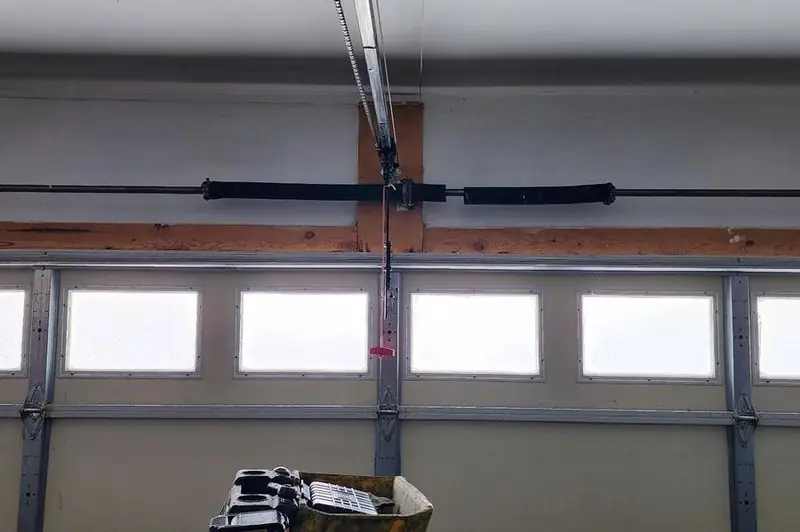
If it feels like your garage door spring always breaks during the coldest stretch of January, you're not imagining it. Extreme cold genuinely does make torsion springs more likely to fail, and Ottawa — where -25°C to -30°C nights are a normal part of winter — sees this pattern every year.
Why metal behaves differently at -30°C
Steel becomes measurably less ductile as temperatures drop. At room temperature, steel flexes and absorbs stress with some give. In extreme cold, that same steel becomes stiffer and more brittle — it has less capacity to flex under load before it cracks or snaps outright. Your garage door's torsion springs are under constant tension even when the door is closed, and that tension doesn't change with the weather. What changes is the spring's ability to tolerate that tension without failing.
How cold changes torsion spring tension and cycle life
Every torsion spring is rated for a certain number of open/close cycles — typically around 10,000 cycles for standard residential springs. That rating assumes moderate operating conditions. In deep cold, the same spring experiences more stress per cycle because the metal doesn't flex as smoothly, which effectively shortens its usable life. A spring that's already near the end of its rated cycle count is the one most likely to snap during a cold snap — the cold doesn't cause failure out of nowhere, it accelerates failure that was already coming.
Warning signs a spring is about to fail in extreme cold
- The door feels noticeably heavier to lift by hand than it used to
- You hear a loud bang from the garage — often the sound of a spring snapping under tension
- Visible gaps or separation in the spring coils
- The door looks uneven or crooked when partially open
- Rust or flaking on the spring coils, which weakens the metal further in the cold
See our broken spring guide for a full breakdown of failure signs and why this is not a DIY repair.
Why springs seem to "always break in January" in Ottawa
Ottawa's climate is a genuine outlier in southern Ontario — Environment Canada climate data shows Ottawa regularly sees stretches of -20°C to -30°C overnight lows in January, colder and more sustained than most of Southern Ontario. Combine that with a spring that's already worn from years of cycling, and January becomes the month where marginal springs finally give out. It's not bad luck — it's the coldest, most stressful month of the year for a component that's already near end-of-life.
Preventive steps before a deep freeze hits
- Have springs inspected each fall before temperatures drop, especially if the door is more than 7–10 years old
- Keep moving parts lubricated with a silicone-based lubricant rated for cold temperatures — never WD-40, which attracts grit and doesn't hold up in the cold
- Address any rust on the springs immediately rather than waiting
- Know your door's age and approximate cycle count — a good rule of thumb is roughly 3–7 years of daily use per residential spring set
What to do if a spring breaks during a cold snap
Stop using the door immediately. A broken spring means the door has no safe counterbalance — attempting to open it manually or with the opener can cause the door to fall suddenly, which is a serious safety risk. Disconnect the opener's manual release if you can safely reach it, leave the door in its current position, and call for emergency service. DPS provides same-day emergency spring replacement across Ottawa, even during the coldest weeks of the year.
Choosing cold-rated springs for a replacement
When replacing springs in a climate like Ottawa's, it's worth using springs built to the correct gauge and cycle rating for your door's exact weight and size, rather than a generic universal-fit spring. A properly matched, correctly wound-and-tensioned spring set handles Ottawa's cold far better than an under-specced replacement — this is one of the reasons professional installation and calibration matters more here than in milder climates.
How extension springs differ from torsion springs in the cold
Most modern residential doors use torsion springs mounted on a shaft above the door, but some older Ottawa homes, particularly in established neighbourhoods, still use extension springs mounted along the horizontal tracks. Extension springs are generally considered more failure-prone in extreme cold because they rely on stretch-and-recoil tension rather than a wound torsion load, and the sudden snap-back of a failed extension spring without a proper safety cable is a more serious safety hazard than a torsion spring failure. If your home still has extension springs, upgrading to a torsion system with a safety cable is worth discussing at your next service visit.
Why the coldest week of the year isn't always when to expect trouble
Interestingly, spring failures don't always spike on the single coldest night — they often cluster in the days immediately following a rapid temperature swing, when the metal has been stressed by the temperature change itself rather than sustained cold. A door that goes from a relatively mild day to a sudden overnight drop of 15-20 degrees is under more acute stress than one that's been consistently cold for a week. This is part of why Ottawa, with its swings between chinook-influenced mild spells and Arctic air masses, sees spring failures scattered across the whole winter rather than only on the coldest calendar day.
How your garage's insulation level affects spring stress
An unheated, uninsulated garage exposes the springs and all hardware to outdoor temperatures continuously, while a garage with even basic insulation and a bit of ambient heat from an attached house wall stays measurably warmer. Homeowners who've insulated their garage or added a small space heater often report less frequent hardware issues over a full winter, not because the door itself changed, but because the operating environment for the springs and rollers is less extreme.
What a professional cold-weather spring inspection actually checks
- Coil spacing and any visible gaps indicating fatigue
- Rust or corrosion, which weakens tensile strength disproportionately in the cold
- Correct tension calibration for the door's actual weight, since incorrect tension accelerates wear regardless of temperature
- Cable and drum condition, since a compromised cable often fails around the same time as an aging spring
- Overall cycle history based on the door's age and how many times per day it's typically used
DPS includes this check as part of our standard service visits across Ottawa, and we recommend scheduling it in October or early November, before the coldest stretch of winter arrives.
FAQ
Does cold weather actually cause springs to break, or just reveal existing weakness?
Both — cold adds real stress to the metal, and it also accelerates failure in springs that are already near the end of their rated life.
Should I bring my garage temperature up before opening the door on a very cold day?
It's not necessary for spring health specifically, but a heated garage does reduce cold-related stress on all moving parts, including the opener motor and door hardware.
How often should springs be replaced in Ottawa's climate?
Most residential torsion springs last 7–12 years with regular use in Ottawa's climate, though heavier doors or more frequent daily cycles shorten that window.