
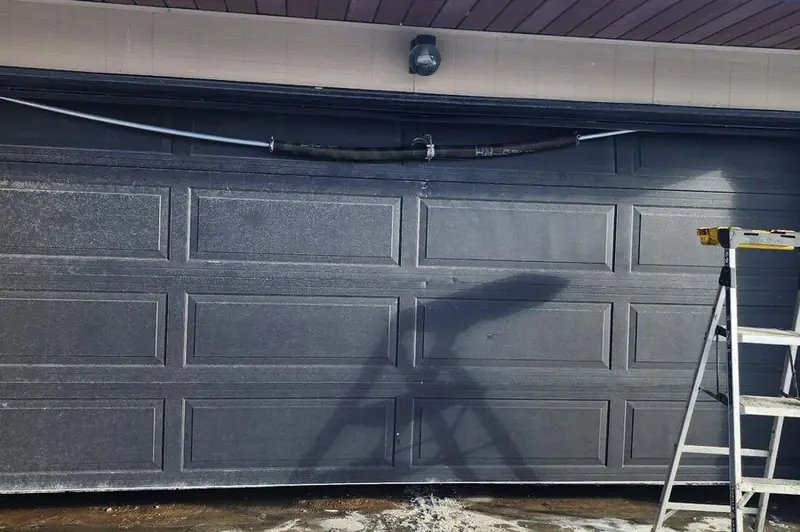
Why springs fail more often in Ottawa
Garage door torsion springs are rated for a certain number of open-close cycles — typically somewhere between 10,000 and 20,000 depending on the spring. In theory that should last a decade or more for an average household. In practice, we replace far more springs across Ottawa each winter than the cycle rating alone would predict, for a few reasons specific to this climate.
Steel becomes measurably more brittle as temperatures drop. A spring that's been slowly fatiguing for years can hold on through a mild fall and then snap the first hard cold snap in January, often with that unmistakable bang that homeowners in neighbourhoods from Orléans to Barrhaven describe as sounding like a car backfiring in the garage. Add in the fact that unheated garages in older Ottawa homes — think the brick bungalows around Alta Vista or the 1970s split-levels in Bells Corners — see far wider temperature swings than an attached, insulated garage in a newer Kanata Lakes build, and you get accelerated wear on the coil.
What actually determines the price
There's no single number that applies to every job, because spring replacement cost depends on real variables:
- Spring type. Torsion springs (mounted on a shaft above the door) are more common on doors installed since the late 1990s and are generally the safer, longer-lasting design. Older doors, particularly on some century homes in Westboro or the Glebe, may still run extension springs mounted along the horizontal tracks.
- Door weight and size. A single-car door on a bungalow needs a lighter spring than a heavy insulated double door on a newer Barrhaven or Findlay Creek build. Heavier doors need higher-rated springs, which cost more.
- One spring vs. a pair. Replacing both springs at once is usually more cost-effective per spring than doing one now and one later.
- Cycle rating. Standard-cycle springs cost less upfront than high-cycle springs, but if you use your garage door often — multiple vehicles, home gym in the garage, teenagers in and out constantly — the higher-cycle option pays for itself in fewer future callouts.
- Access and hardware condition. If cables, rollers, or the bottom bracket are also worn, addressing them at the same visit avoids a second service call.
We give you an exact, written number after a quick look at your door — call (613) 884-1488 and we'll walk you through it before any work starts.
Signs your spring is about to go
A spring rarely fails with zero warning. Watch for:
- The door feels noticeably heavier when lifted manually.
- The opener strains, grinds, or reverses partway through a cycle.
- A visible gap appears in the coil of a torsion spring mounted above the door.
- The door looks crooked, with one side higher than the other when opening.
- A loud, sudden bang from the garage — this usually means it has already broken.
If you notice any of these, stop using the opener. Running a motor against a broken or failing spring puts extra strain on the drive gear and can strip it, turning a spring job into a spring-and-opener job.
Repair vs. replace: when a new door makes more sense
Spring replacement is almost always the right call on its own. But if your door is 20+ years old, has multiple failing components (worn rollers, a bent track, a cracked panel), or you're already thinking about upgrading insulation for an Ottawa winter, it's worth getting a second opinion on whether a full door replacement makes more financial sense than repeatedly patching an aging system. Our Door Guide breaks down current door options if you want to compare.
How DPS handles spring calls across the region
Our trucks carry a range of torsion and extension spring sizes so most Ottawa-area calls are same-day. We measure wire diameter, coil length, and inside diameter against your door's actual weight rather than guessing off a general chart, replace in pairs when it makes sense, then balance the door (it should stay level and stationary when raised halfway) and cycle-test it before we leave. Every spring job is backed by our written warranty.
Torsion springs vs extension springs: cost differences
Most homes built or renovated in the last twenty-five years use torsion springs — the type mounted horizontally on a metal shaft directly above the closed door, wound tight to store lifting energy. Older homes across neighbourhoods like the Golden Triangle or parts of Overbrook sometimes still run extension springs, mounted along the horizontal tracks and stretching as the door closes. Extension spring replacement is often slightly less involved than torsion, but torsion systems are generally considered safer and more durable over the long run, which is why most replacements on older doors end up converting to torsion hardware rather than simply swapping in another extension spring.
If your garage still has the original extension springs from a build in the 1970s or 1980s, it's worth asking your technician whether a torsion conversion makes sense at replacement time. It costs a bit more upfront but often means fewer future callouts.
What a fair, honest quote actually includes
When you call around for pricing, make sure any quote you're comparing actually includes the same scope of work. A legitimate spring replacement quote should cover:
- The correct spring or spring pair sized to your door's actual measured weight, not a generic estimate.
- Labour to remove the old spring(s) safely and install the new ones.
- A full balance check and adjustment once installed — the door should stay level and hold its position when lifted halfway.
- A cycle test through several full open-close cycles to confirm smooth, quiet operation.
- A written warranty on both the part and the labour.
Quotes that omit balancing or warranty coverage can look cheaper on paper but often cost more in the long run if the door isn't properly tensioned afterward, which accelerates wear on the opener and cables.
How spring problems connect to other repairs
A broken spring rarely travels alone. Because the opener has to work harder the moment a spring loses tension, technicians commonly find secondary wear on the drive gear, cables, or rollers when they arrive for a spring call — especially if the door was used on the opener for even a few cycles after the spring failed. This is part of why we do a full hardware check on every spring visit rather than just swapping the part and leaving. If your opener has been under extra strain, it's worth reading our guide on garage door opener not working to see if any of those warning signs apply to your situation too.
Cost-saving tips that don't compromise safety
- Don't wait for a total failure. Replacing a visibly fatigued spring before it snaps is usually simpler and can prevent secondary damage to cables or the opener that a sudden failure sometimes causes.
- Bundle it with other overdue maintenance. If rollers or cables are also due, doing everything in one visit saves a second service call fee.
- Ask about high-cycle springs if you use the door heavily. The upfront cost is a bit higher, but for a household running the door multiple times a day, the extended lifespan often pays for itself.
- Keep your invoice and warranty paperwork. If a problem develops within the warranty period, having documentation on hand speeds up the fix considerably.
A quick word on financing a spring repair
Because spring failures tend to arrive unannounced, cost is often the first concern homeowners raise on the phone. If a same-day repair puts pressure on your budget, ask about flexible payment options when you book — spreading the cost doesn't need to delay getting your door safely operational again.
Comparing quotes without just chasing the lowest number
If you're getting more than one quote for a spring replacement, ask each company what specific spring type, wire gauge, and cycle-life rating they're proposing — not just a total dollar figure. Two quotes with a meaningful price gap sometimes reflect genuinely different spring quality rather than one company simply charging more for the same part, and that distinction matters far more to your long-term cost than the sticker price alone.
For more on how spring failures tie into winter generally, see our guide on extreme cold and garage door springs and our related post on recognizing a failing spring before it breaks. If you're in Kanata, Nepean, or Orléans specifically, our Kanata garage door repair, Nepean garage door repair, and Orléans garage door repair pages have local service details.